State of Human Longevity Evidence · 2026 Q3
What our coverage measures—and what it cannot prove.
A transparent snapshot of 48 source-reviewed stories: their primary outcome, study design, topic, population, measured results and publication format. The picture is useful for navigating MoreYears.news, not for ranking interventions or estimating the wider field.

By Lois Rune
Read this first: these are counts of MoreYears.news stories, not scores of evidence quality, treatment rankings, or estimates of how much research exists. A story can carry several measured-result tags, but it appears in exactly one primary outcome group.
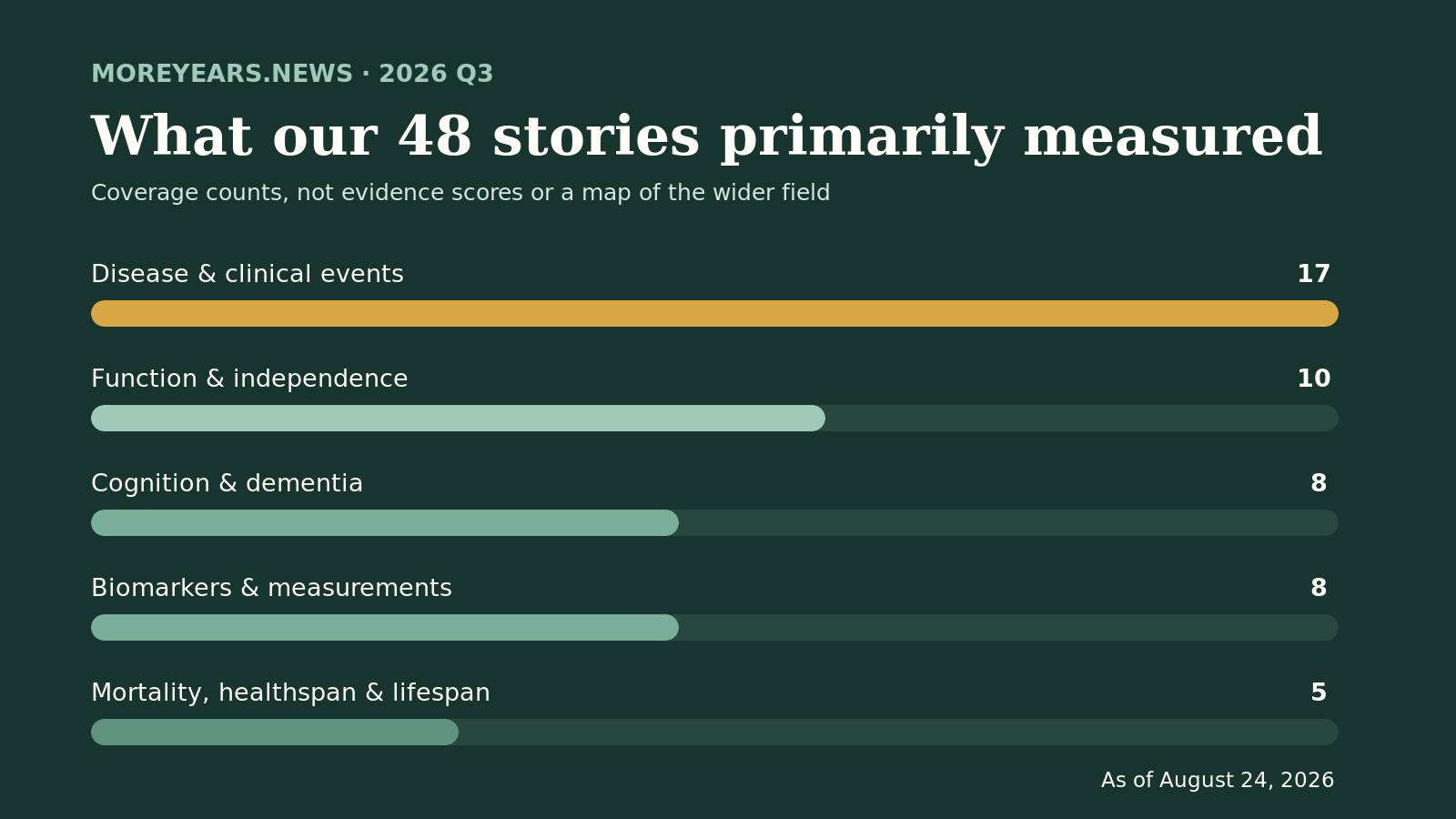
One story, one primary group
Clinical events are the largest primary outcome in this edition.
Primary grouping is a navigation choice based on the outcome foregrounded in the released story. It prevents duplicate stories in the tracker; it does not collapse every endpoint studied.
| Primary outcome group | Stories |
|---|---|
| Disease & clinical events | 17 |
| Function & independence | 10 |
| Cognition & dementia | 8 |
| Biomarkers & measurements | 8 |
| Mortality, healthspan & lifespan | 5 |
| Total | 48 |
Study design
Thirty-six stories cover randomized evidence; scale and maturity still vary.
The tracker preserves its governed design labels. “Randomized” does not by itself establish generalizability, adequate power, meaningful outcomes, safety or longer life.
Evidence designs
Publication formats
Topics and measured results
Topic coverage is broad; measured-result tags overlap by design.
Category counts total 48. Measured-result counts total 83 because one story may report, for example, both clinical events and mortality. Those facets are filters, not independent studies or votes.
Primary topic category
Measured-result facets · overlapping
Coverage boundary
What this snapshot cannot tell us.
It is not the literature.
The denominator is 48 stories published here, not every eligible study. More coverage in a category can reflect editorial sequencing, not scientific importance.
It is not an efficacy ranking.
Counts do not compare effect sizes, certainty, harms, applicability or treatment value. No bar answers “what works best?”
It does not turn a measurement into healthspan.
Biomarkers, physiology, clinical events, function and survival remain separate outcomes. A change in one does not establish another.
“Human” is not “for everyone.”
All 48 tracker rows concern people, but eligibility, age, health status, setting, dose and follow-up differ. Population labels remain attached to each underlying story.
Reproducible method
How the snapshot was made.
- Freeze the canonical tracker and published-coverage manifests at their August 24, 2026 state.
- Require exactly one tracker row for every released article route and preserve each governed vocabulary identifier.
- Count primary outcome, design, category and population once per story.
- Count each measured-result facet independently, disclose the 83-assignment overlap, and never use the totals as scores.
- Store the 48 included record identities, frozen publication formats, aggregate values and source digests in
data/state-of-human-longevity-evidence.jsonso future editions can be compared without silently rewriting this one. - Keep unknown, not assessed, no posted results and not applicable distinct from zero. This edition has no unknown population-type rows: all 48 tracker records are labeled People.
Corrections to an underlying story remain governed by the corrections policy. A later report will receive a new edition and snapshot rather than changing this edition’s denominator without disclosure.