Research Analysis · Health & function
A review found healthspan signals—and no common effect
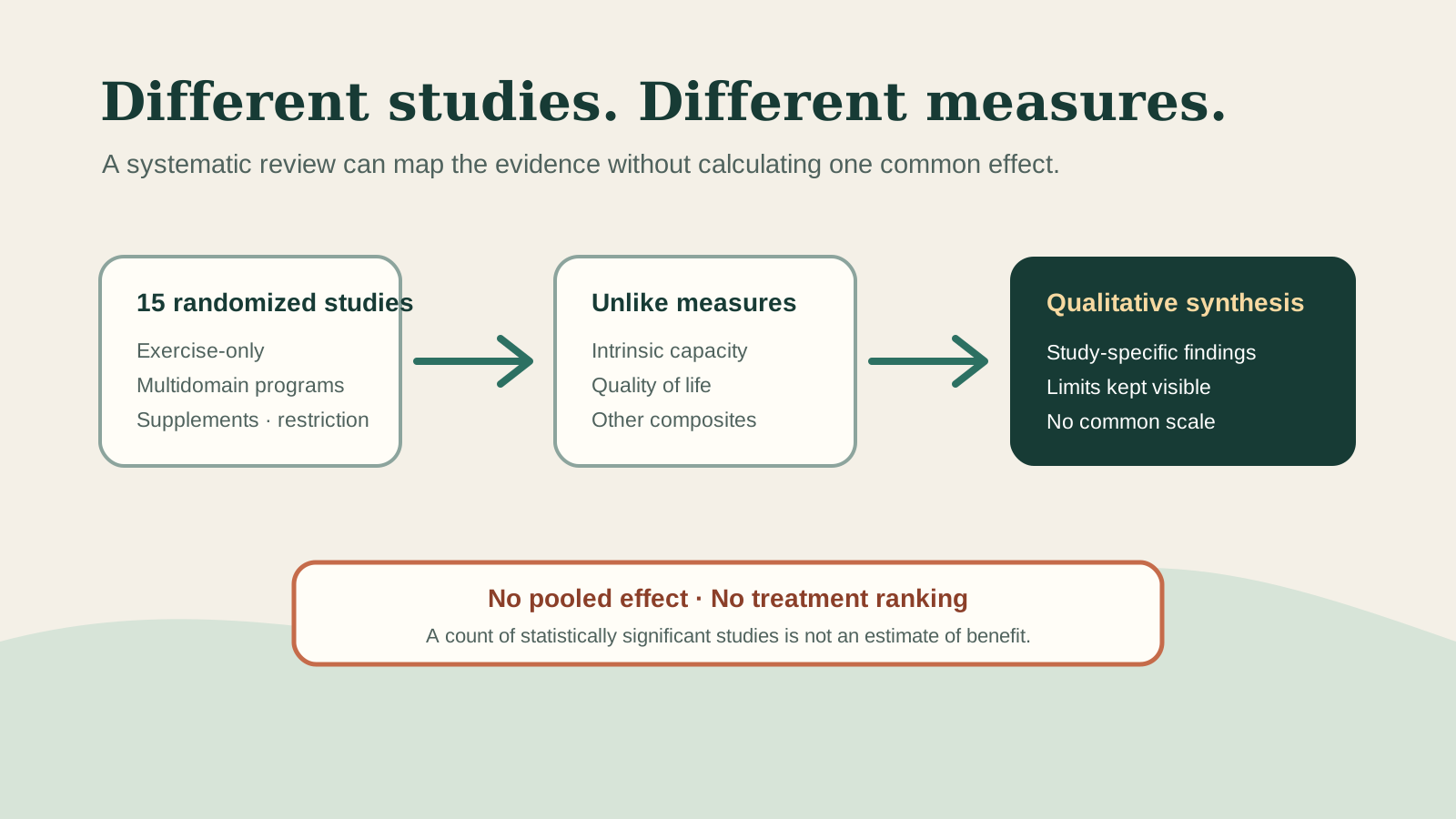
Fifteen randomized studies measured intrinsic capacity, quality of life or other multidimensional scores. Their results could be described study by study—not combined into extra healthy years or a treatment ranking.
Evidence scope
Registered systematic review with qualitative synthesis
- Population
- 4,656 participants across 15 unique randomized studies; mostly older adults in North America, Europe and Asia
- Design
- systematic review of randomized and cluster-randomized trials, searched through October 16, 2025
- Measured outcomes
- intrinsic capacity, quality of life or another measure combining more than one physical or psychological domain
- Evidence maturity
- peer-reviewed registered review; qualitative synthesis only, with no meta-analysis or overall effect estimate
- Main result
- 13 of 15 studies were labelled statistically beneficial; 11 of 13 exercise or multidomain studies were labelled positive, but effects were generally small and clinical importance unclear
- Certainty assessment
- none reported; the PRISMA checklist marks certainty assessment not applicable
- Publication status
- first online May 22, 2026; corrected and typeset June 23; no linked correction, concern or retraction found October 14
- Funding & conflicts
- Monash scholarships and fellowship plus an NHMRC grant; funders reportedly had no role; no conflicts declared
- Safety & regulatory boundary
- the review is not a safety comparison, product authorization or reason to adopt a study program or supplement without its exact clinical context
Bottom line: Some randomized studies reported changes on multidimensional function or well-being scores, especially in exercise-containing programs. The review did not estimate how large one common benefit was.
Not established: more years of healthy life, disease prevention, mortality benefit, a “best” intervention, benefit from every exercise program, or an individual recommendation.
“Healthspan” meant multidimensional function or well-being
Healthspan has many definitions. This review used a particular one: an outcome had to combine more than one aspect of physical or psychological functioning. Eight studies used intrinsic-capacity scores, usually drawing from domains such as cognition, locomotion, vitality and psychological function. Six used quality-of-life instruments, and two used other multicomponent constructs.
That eligibility rule deliberately left out biomarker-only studies, single measures of physical or cognitive performance, genetic variants and disease-only outcomes. It also means the review was not measuring one settled quantity called healthspan. Intrinsic capacity, self-reported quality of life, disability-free survival, absence of disease, a biological-age score, mortality and lifespan answer different questions. None can be silently converted into another.
Fifteen studies were eligible—and they differed sharply
The researchers searched MEDLINE, Embase, ClinicalTrials.gov and reference lists. After removing duplicates, they screened 1,960 records, reviewed 71 full texts and excluded 56. The remaining 15 articles each represented a unique study and together included 4,656 participants.
Study sizes ranged from 49 to 1,445 people. Mean ages ranged from 38 to 84, although nine studies had a mean age above 70. The programs lasted as little as seven days and as long as three years. Some participants were community-dwelling older adults; others had frailty, chronic conditions or metastatic breast cancer. Those differences matter before any headline is generalized.
What could be combined?
A map of studies, not one effect size
The intervention counts overlap
Seven studies were grouped as exercise-only. Six were multidomain, and every one of those included exercise alongside some combination of cognitive training, nutrition, health education, stress management or clinical care. Two studies involved daily supplements, while one involved caloric restriction.
Those numbers cannot be added as four mutually exclusive buckets. One omega-3 study was also a multidomain study. Looking at components instead, 12 of 15 studies included exercise, five included nutrition through supplementation, restriction or advice, and six included cognitive training. This overlap is why the review cannot tell readers whether a nutrition or cognitive component caused a change inside a combined program.
Eleven positive studies is not a pooled benefit
The authors reported that 13 of 15 studies had a statistically beneficial result on their selected multidimensional indicator. Within exercise-only and multidomain groups, 11 of 13 were labelled positive: six of seven exercise-only studies and five of six multidomain studies.
That count is descriptive. It does not retain how large each estimate was, how precise it was, whether a score crossed a meaningful clinical threshold, or how the null and positive studies differed. The Cochrane Handbook warns against using statistical-significance counts as a substitute for an effect estimate. Here, the review itself says effects were generally small and their clinical importance unclear.
There was no meta-analysis because the programs and outcomes were too heterogeneous. So there is no pooled percentage, standardized gain or probability that MoreYears.news can report. “Most studies were positive” is not equivalent to “the intervention adds healthy years.”
Risk of bias and applicability narrow the result
The review used the RoB 2 tool. Most studies were judged low-to-moderate risk of bias. One was rated high risk, mainly because the outcome was self-reported, and one study had moderate concerns in four of five domains. Exercise and behavioral programs are also difficult to blind, self-reported well-being can shift with expectations, and simply knowing one is in a study can affect behavior.
All but one study was conducted in a high- or upper-middle-income setting. The authors said the evidence was most applicable to older Caucasian and Asian adults in North America, Europe and Asia—not to every country or younger population. Trials often excluded people unable to exercise safely, which may have selected participants healthier than their peers.
The supplement’s PRISMA checklist marks certainty assessment as not applicable. Risk-of-bias ratings for individual studies are useful, but they are not a formal rating of confidence in the entire body of evidence. Assigning a GRADE label after the fact would invent a judgment the review did not make.
Single studies cannot carry an intervention class
One caloric-restriction study reported a quality-of-life result after two years. One 60-day NMN study reported quality-of-life differences across doses. The omega-3 study reported no effect, but it also combined supplementation with exercise and other components.
Those results are not enough to establish caloric restriction, NMN, omega-3 products or supplements as classes for extending healthspan. They used different products, programs, populations and outcomes, and the review supplied no common effect or certainty rating. A study-level signal also does not establish safety, regulatory approval, disease prevention or lifespan benefit.
Funding, conflicts and publication status
The review reports Monash International Tuition and Graduate Scholarships, an NHMRC Leadership 1 Investigator Grant and a Monash early-career fellowship. The authors said funders had no role in design, methods, data collection, analysis or preparation, and they declared no conflicts of interest.
Oxford Academic records publication on May 22, 2026, followed by “corrected and typeset” on June 23 and placement in the July issue. That history is not a correction notice. PubMed and PMC showed no linked correction, expression of concern or retraction in the October 14 check. The paper identifies PROSPERO registration CRD420251015780; the registry page itself did not render during the bounded check, so no unobserved registry fields are inferred here.
Sources and editorial method
Three separately recorded research passes and a twenty-claim evidence map were completed before prose. A separate post-draft evidence review then checked every scientific statement and the explanatory figure against that frozen map; it found no unsupported claim. A release-time source and status recheck is still required. See issue #195.
- Zheng et al., systematic review version of record
- PubMed record: PMID 42172592
- Full text: PMCID PMC13290488
- PROSPERO registration: CRD420251015780
- Cochrane Handbook Chapter 12: synthesis without meta-analysis
For connected coverage, read the exercise living evidence page, calorie-restriction living evidence page and research-methods guide.
AI disclosure: AI-assisted research and drafting began only after the evidence map was frozen. Primary identity, methods, supplement, quantitative results, limitations, funding, disclosure and publication status were checked against the evidence record. This article is educational and not medical advice.
Connected evidence
Explore more evidence on health and independence
Keep the measures distinct
More on the outcomes that shape healthy aging
Read the wider exercise evidence without an aging claim
Exercise has strong evidence for function—not proof of slower biological aging
Human trials support mobility and physical function in defined populations. Lifespan and biological-age claims require separate evidence.
Evidence scopeHuman function · mature randomized evidence
See what the one caloric-restriction program actually tested
CALERIE tested calorie restriction for two years—not human lifespan
A randomized trial found selected cardiometabolic improvements, while aging-biomarker results were mixed and lifespan was not measured.
Evidence scopeHuman outcomes and biomarkers · randomized trial
Publication history
- October 14, 2026 — three separately documented research passes and a twenty-claim evidence map were completed before drafting.
- October 14, 2026 — Oxford, PubMed, PMC, the full supplement and an independent Cochrane methods source were checked; no linked correction notice was found.
- October 14, 2026 — separate post-draft evidence review found no unsupported scientific statement or figure label. Release-time source/status recheck, exact-head CI, rendered review, deployment and production verification remain required before completion credit.