Research Analysis · Health & function
ASPREE’s broader healthspan composite stayed near the null
A later analysis combined five very different first events. Aspirin and placebo rates were nearly identical—but the way the endpoint was built matters as much as the result.
Evidence scope
Secondary analysis of a randomized primary-prevention trial
- Population
- 19,114 generally healthy community-dwelling adults, mostly age 70 or older, in Australia and the United States
- Design
- intention-to-treat reanalysis of ASPREE’s randomized 100 mg aspirin-versus-placebo treatment phase
- Measured outcome
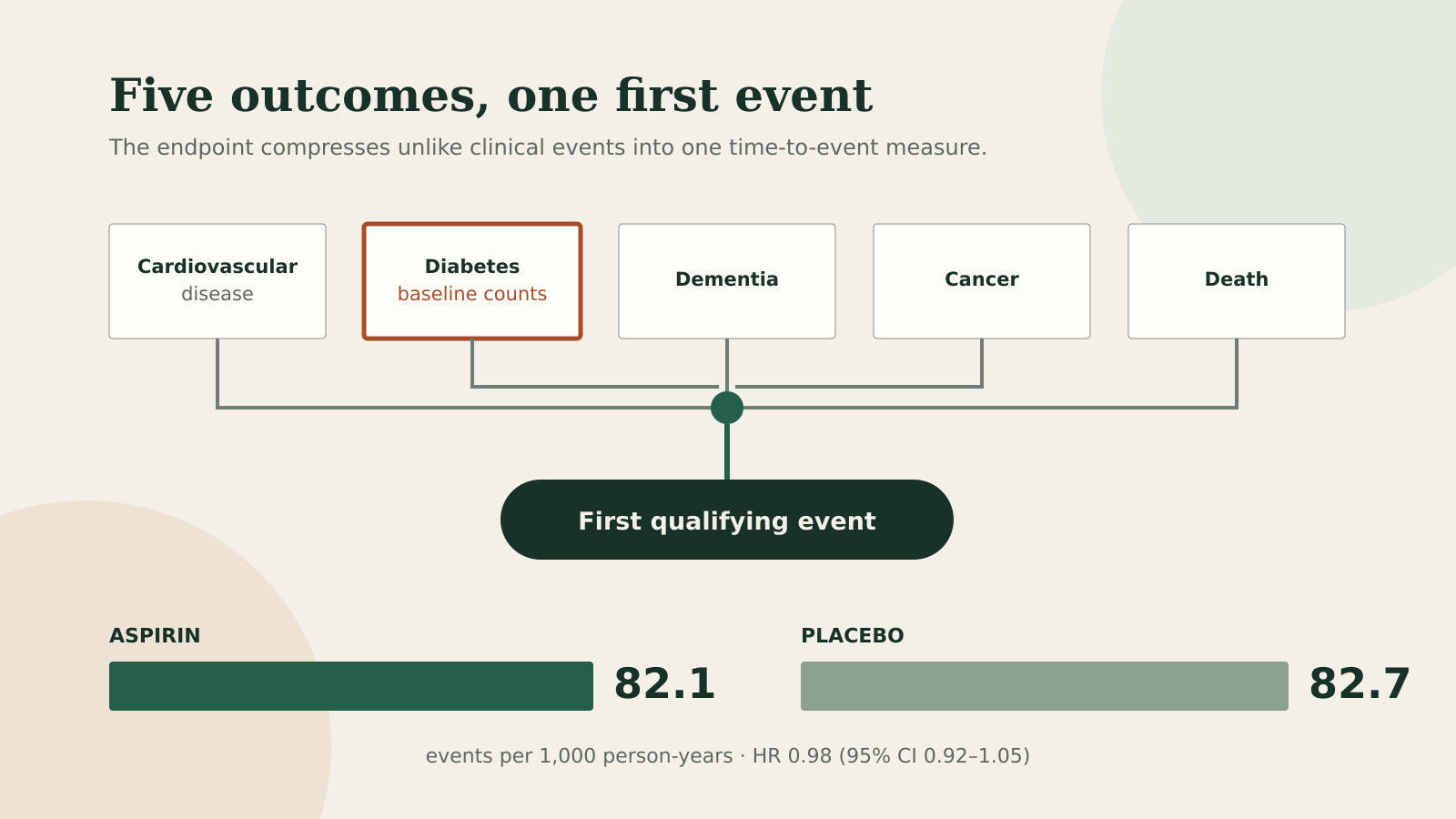
- time to first cardiovascular disease, diabetes, dementia, cancer or death event
- Evidence maturity
- peer-reviewed secondary composite analysis; “loss of healthspan” was not an ASPREE main outcome
- Main estimate
- 82.1 versus 82.7 events per 1,000 person-years; HR 0.98, 95% CI 0.92–1.05
- Publication status
- Version of Record; PubMed indexes July 2, 2026, while the publisher displays July 24; no linked notice found in the October 12 release recheck
- Funding & conflicts
- government and institutional support; authors declared no competing interests. Bayer supplied trial tablets in kind and, according to the trial record, had no other role.
- Safety context
- the original ASPREE cardiovascular report found more major hemorrhage with aspirin
Bottom line: Daily low-dose aspirin did not show a material difference in this five-part composite over median 4.7 years.
Not established: proof of zero effect, a component-specific effect, longer healthy life, a beneficiary subgroup or advice for an individual.
The estimate was close to the null
ASPREE originally randomized 19,114 older adults to 100 mg of aspirin daily or matching placebo. In this later analysis, 5,835 participants—30.5%—met the five-part composite during 70,813 person-years. There were 2,896 events in the aspirin group and 2,939 in the placebo group.
That translated to 82.1 versus 82.7 events per 1,000 person-years. The hazard ratio was 0.98, with a 95% confidence interval from 0.92 to 1.05. The best estimate sits close to no difference, and the interval excludes neither a modest benefit nor a modest harm. It is more accurate to say the study did not show a material difference than to claim aspirin had exactly zero effect.
How the endpoint worked
Five outcomes, one first event
events per 1,000 person-years
“Healthspan” here is an operational definition
The paper defined loss of healthspan as the first occurrence of cardiovascular disease, diabetes, dementia, cancer or death. This creates a tractable time-to-event analysis, but it does not directly count healthy years. Nor does it capture quality of life, the severity of an event, recovery, recurrent disease or what happened after the first event.
The five components are also not clinically interchangeable. A diabetes diagnosis at enrollment, a later cancer diagnosis and death all end the composite in the same way. That may be useful for testing one broad hypothesis, but it cannot reveal whether aspirin affected any single component unless those outcomes are analyzed appropriately on their own.
Baseline diabetes shaped the composite
Diabetes was the largest reported first-event category: 2,803 people. Of them, 2,045 already had diabetes when they entered ASPREE and therefore contributed an event at time zero. Treatment assigned at randomization could not have prevented a condition already present.
Cancer was the most common incident component during follow-up. The paper also reported 727 cardiovascular-disease, 456 dementia and 294 death first events. These descriptive counts explain the endpoint’s composition; they do not establish separate aspirin effects. The reported component tallies should not simply be added and treated as an exact partition of 5,835 people.
Alternative definitions did not change the main message
The researchers repeated the analysis three ways. Excluding people with baseline diabetes produced HR 0.98 (95% CI 0.92–1.05). Adding persistent physical disability produced HR 1.00 (0.94–1.07). Removing diabetes from the composite produced HR 0.97 (0.92–1.04). All three estimates stayed near the null.
No reported subgroup estimate establishes benefit. Estimates highlighted for 488 Hispanic or Latino participants and for participants with overweight both had confidence intervals that crossed one. Small groups, many comparisons and imprecision make those signals hypothesis-generating, not a basis for treatment selection.
This was not ASPREE’s original primary endpoint
ASPREE’s prespecified primary outcome was disability-free survival: survival free of dementia or persistent physical disability. That randomized report did not show a significant benefit from aspirin. The five-part composite in the 2026 paper was built later and answers a different question.
Randomization still strengthens the aspirin-versus-placebo comparison. It reduces confounding for assigned treatment. It does not automatically validate every later endpoint as a measure of healthspan, and it does not turn a secondary analysis into a new randomized trial.
The paper labels its subgroup factors prespecified, but that does not make this later composite an ASPREE main outcome. The hazard ratio came from an intention-to-treat Cox model; competing-risks regression was used for the cumulative-incidence curves. Death was included in the composite, and the analysis followed the first event rather than counting recurrent events.
Bleeding and population limits remain central
These participants were selected older adults without known cardiovascular disease, dementia or major physical disability and without a separate clinical indication for aspirin. The analysis does not directly answer questions about younger adults, secondary prevention after a cardiovascular event, or people prescribed aspirin for another reason.
The original ASPREE cardiovascular report found no significant reduction in cardiovascular events and more major hemorrhage with aspirin. That safety result cannot be erased by a later composite. This article is not advice to start, continue or stop aspirin; decisions depend on indication, age, cardiovascular risk, bleeding risk, other medicines and clinician guidance.
Funding and disclosure context
The 2026 paper reports support from the US National Institutes of Health, Australia’s National Health and Medical Research Council, Monash University and the Victorian Cancer Agency. The authors declared no competing interests and said funders had no role in study design, data collection, analysis or manuscript preparation.
The broader ASPREE record says Bayer supplied aspirin and matching placebo in kind and had no other trial role. Reporting both statements preserves the distinction between the paper’s author disclosures and the trial’s product-supply history.
Sources and editorial method
Three research passes were completed before prose. A separate post-draft review then checked every medical and quantitative sentence against S90-01 through S90-20; no unsupported claim was found. Publisher, bibliographic, registry, safety and disclosure status were rechecked on October 12 before release. See issue #191.
- Zheng et al., ASPREE healthspan analysis
- PubMed record: PMID 42497096
- Full text: PMCID PMC13398386
- ASPREE registry: NCT01038583
- Original ASPREE disability-free-survival report
- Original ASPREE cardiovascular and bleeding report
- FDA aspirin safety questions and answers
For the wider trial record, see the low-dose aspirin living evidence page.
AI disclosure: AI-assisted research and drafting were used only after the evidence map was frozen. Primary identity, methods, quantitative results, limitations, funding, disclosure and publication status were checked against the evidence record. This article is educational and not medical advice.
Connected evidence
Follow this result through the evidence system
Explore more evidence on health and independence
More on the outcomes that shape healthy aging
Compare the trial’s prespecified primary endpoint
ASPREE found no gain in disability-free survival—and more major bleeding
In 19,114 selected older adults, daily low-dose aspirin did not improve the trial’s composite of death, dementia or persistent physical disability over a median 4.7 years. Major hemorrhage was higher.
Evidence scopeHuman function and safety · large randomized trial
Keep cardiovascular benefit and bleeding harm separate
ASPREE did not lower cardiovascular events—and increased major bleeding
In selected older adults without cardiovascular disease, low-dose aspirin did not significantly reduce the trial’s cardiovascular composite. Major hemorrhage occurred more often.
Evidence scopeHuman cardiovascular and safety outcomes · large randomized trial
Publication history
- October 11, 2026 — three separately documented research passes and a twenty-claim evidence map were completed before drafting.
- October 12, 2026 — separate claim-by-claim evidence review found no unsupported medical or quantitative claim; the visual’s baseline-versus-incident distinction also passed.
- October 12, 2026 — publisher, PubMed, registry, primary-trial, FDA safety, funding and disclosure status were rechecked; no claim-changing update or linked correction notice was found.
- October 13, 2026 — publication metadata aligned to the current release candidate; the October 11 research and staging history is preserved. Live delivery is recorded separately in the release record.